Interactive bridge discovery
How well do you know Stari Most?
Open 12 points to discover the history, engineering and traditions of Mostar's Old Bridge—then see how much you remember.
- 12story points
- 8quiz questions
- 8principal sources
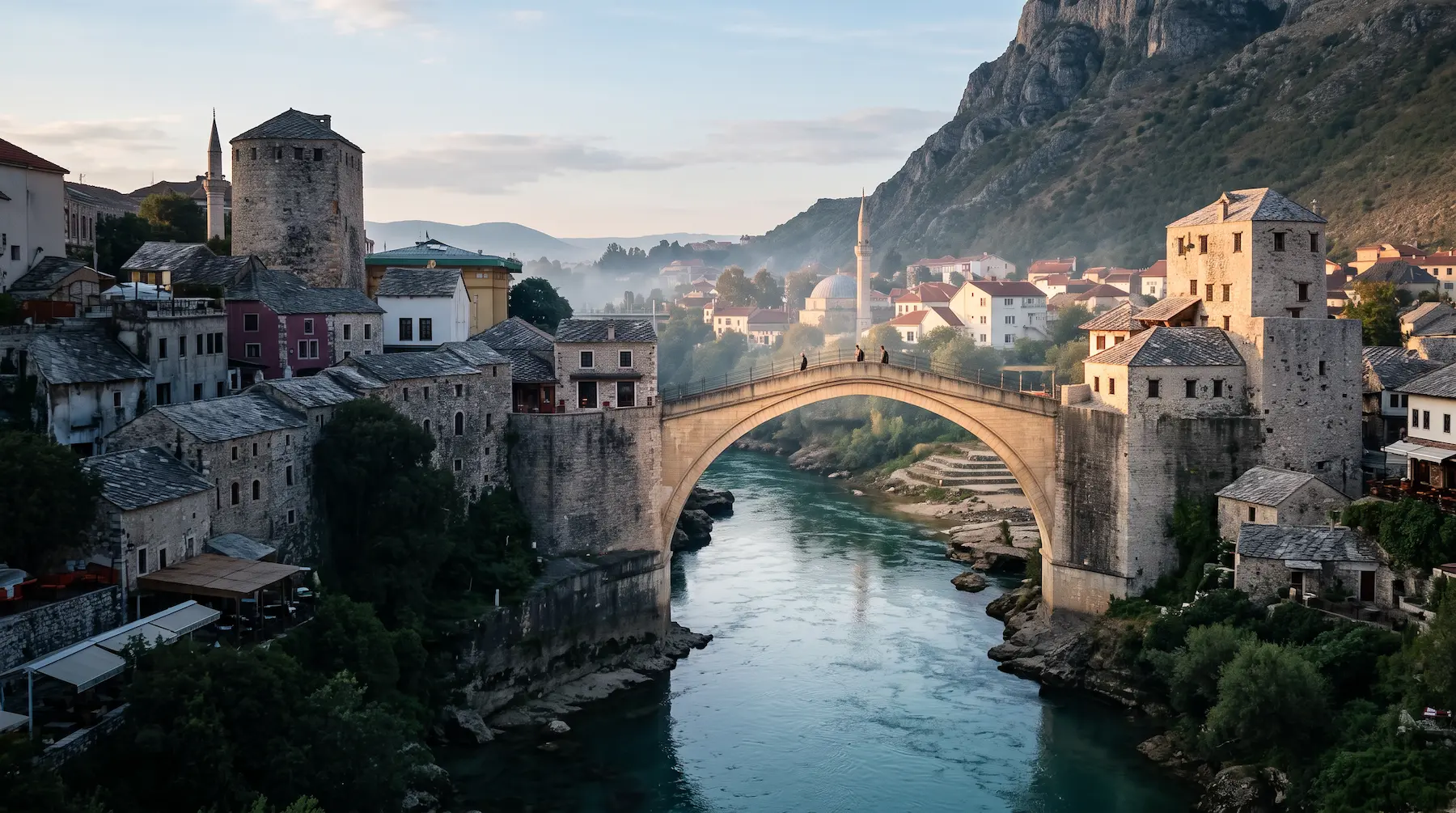
Research note: Historical claims were source-checked on 13 September 2026. The bridge image is AI-created and illustrative—not documentary photography.
Choose a point
Explore the bridge, one story at a time
Select any numbered marker. Every story is also available in the accessible, crawlable list immediately below.
All 12 stories
The facts, context and sources
Open each story for the fuller explanation. Where evidence is incomplete, the page says so explicitly.
01Earlier crossingBefore the stone bridge
Mostar had an earlier bridge crossing before the celebrated stone arch. UNESCO's evaluation records a settlement with two defensive towers around a bridge dated to 1459 and describes the earlier wooden bridge as a route used by soldiers, traders and other travellers.
Source: UNESCO/ICOMOS evaluation
02Name and identityThe name Mostar predates the stone bridge
Mostar appears in written sources in 1474. Its name is associated with mostari—bridge keepers—so the name refers to guardians of the earlier crossing rather than specifically to the stone bridge completed in 1566.
Source: UNESCO World Heritage Centre
03Commission and designA sultan, an architect and a demanding commission
Sultan Süleyman the Magnificent commissioned the new bridge in 1557. It was designed by Mimar Hayruddin, whom the Aga Khan Development Network describes as a student and apprentice of the celebrated Ottoman architect Mimar Sinan.
Source: Aga Khan Development Network
041557–1566Nine years in the making
05Lifespan and lossThe original stood for about 427 years
From its completion in 1566 until its destruction on 9 November 1993, the original stone bridge stood for approximately 427 years. The present bridge reopened in the summer of 2004 after an international reconstruction programme.
Sources: UNESCO listing and UNESCO reconstruction account
06River and measurementWhy do sources say 20, 21 or 24 metres?
Reputable descriptions do not all use the same figure. UNESCO's restoration summary says 20 metres above maximum summer water level, official Mostar tourism information gives roughly 21 metres above summer water, and reporting about the diving tradition frequently cites about 24 metres. The Neretva's changing level and the chosen measurement point affect the result.
Sources: UNESCO restoration summary, Mostar tourism and Reuters
07Physical dimensionsLength, width and span are not interchangeable
Official descriptions use slightly different measurement conventions. Mostar tourism gives approximately 28.7 metres long and 4.49 metres wide; a UNESCO restoration summary rounds these to 30 metres and 4 metres while separately giving the arch opening as 27 metres. This page therefore avoids presenting a rounded 29 metres as an exact structural span.
Sources: Mostar tourism and UNESCO restoration summary
08Two banksTara to the east, Halebija to the west
Tara Tower stands on the eastern, conventionally left bank and today houses the Old Bridge Museum. Halebija Tower is on the western, right bank. Colourful stories about how the towers acquired their names have been left out because they could not yet be confirmed from sufficiently authoritative sources.
Sources: UNESCO restoration summary and Mostar tourism: Tara and Halebija Towers
091999–2004Rebuilt from the original quarry—not entirely from original stones
The reconstruction principally used newly quarried tenelija stone from the same local quarry associated with the 16th-century bridge. Some surviving historic material was incorporated, especially in visible surface areas, but it is misleading to say the whole bridge was rebuilt from stones recovered from the river.
Sources: UNESCO reconstruction account and UNESCO/ICOMOS evaluation
10World HeritageUNESCO recognition followed reconstruction
The Old Bridge Area of the Old City of Mostar joined the UNESCO World Heritage List in 2005. UNESCO presents the reconstructed bridge and Old City as symbols of reconciliation, international cooperation and the coexistence of different communities.
Source: UNESCO World Heritage Centre
11Traffic and open researchA wartime tank—and a count we will not guess
A UNESCO restoration summary records the surprising fact that the bridge supported the passage of Nazi tanks during the Second World War. That demonstrates exceptional strength, but it does not by itself prove that wheeled carts routinely crossed the steep stone deck in earlier centuries. The deck's raised transverse ribs create its characteristic rhythm; because published “step counts” vary, StariMost.com will publish a number only after an on-site count and photographic record using a clear method.
Source: UNESCO restoration summary. On-site rib count and photographic verification pending.
12Living traditionFeet-first and the head-first “swallow”
Mostar's traditional diving competition recognises feet-first and head-first disciplines; the head-first style is famously called lasta, or “swallow.” The tradition is locally described as more than 450 years old, which is best understood as a maintained heritage claim rather than an uninterrupted documented record. The Red Bull Cliff Diving World Series first came to Mostar in 2015.
Safety: Jumping from Stari Most is extremely dangerous and should never be attempted casually. Organised dives involve trained participants and controlled conditions.
Eight-question challenge
Now test your bridge knowledge
Nothing is sent or stored. Your score is calculated only in your browser.
Editorial transparency
What we know—and what we have not invented
The page deliberately distinguishes sourced facts, measurements that vary, local heritage claims and questions still requiring first-hand verification. It does not turn a documented wartime tank crossing into an unsupported claim about routine cart traffic, or publish a step count or colourful tower-name story as settled fact.
Editorial research by StariMost.com · Reviewed 13 September 2026